Aug 15, 2016
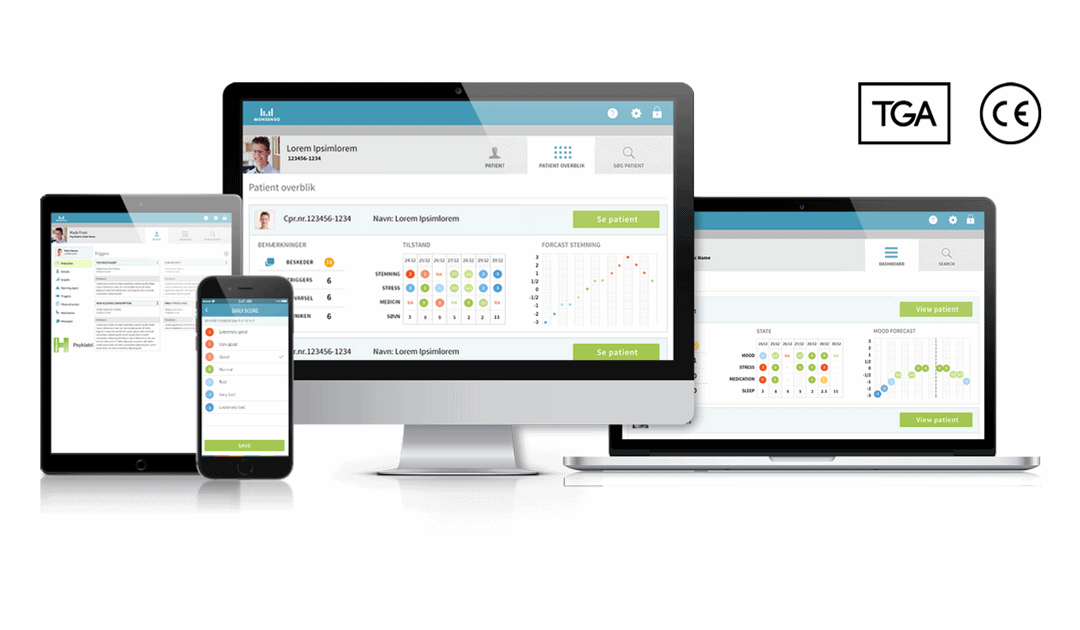
Copenhagen, Denmark – 16 August 2016. Monsenso, today announced that its mHealth solution received a Class I medical-device certification, from the Australian Register of Therapeutic Goods Administration (TGA).
The mHealth solution received the TGA certification in cooperation with Emergo, a consultancy company specialising in regulatory compliance for medical devices, with funding from the Danish Market Development Fund.
Thomas Lethenborg, CEO at Monsenso, commented “We are very satisfied that the Monsenso mHealth solution received the TGA certification and is now ready to be launched in the Australian market. Although we already have a customer in Australia, this certification provides us with the means to commercialise the solution nation-wide.”
This certification guarantees that a manufacturer’s product meets the essential requirements stipulated by the Australian Register of Terapeutic Administration.
“Holding the right certifications, and offering a high level of data security is essential for healthcare providers in all markets –including Australia. Therefore, it is important that Monsenso possesses the necessary quality control standards and adequate security measures to succeed world-wide” added Mr. Lethenborg.
The next steps for Monsenso are to obtain the ISO 13485 Certification; the ISO 27001 Data Security Certification; and to become HIPAA and FDA compliant. These certifications will be also obtained with the monetary support granted by the Danish Market Development Fund. You can download this article as PDF in English and Danish.
Note:
As of 23 May 2023, Monsenso does no longer hold the TGA certification.

Aug 9, 2016
Using apps for mental health was written by Ross Campbell, Chief Underwriter of Research & Development based in Gen Re London.
It was originally published on the Gen Re blog and it is © published with the permission of General Reinsurance AG 2016.
Improved awareness and recognition of mental health problems and their complexity puts pressure on health systems to increase care. This stimulates exploration of the potential value of software applications (apps) run on mobile devices. The ubiquity of smartphones makes them an ideal tool for apps that can help individuals manage mental health.
Apps create long-term patient health data in a way that episodic clinic consultations cannot. They generate a personal health record fundamentally different from a clinical patient record [1]. Doctors have much to gain from the comprehensive and detailed information gathered by this form of continuous monitoring. Insurers can also benefit from the potential of this technology, especially for claims.
Apps for mental health can monitor physiological cues associated with sleep disturbance, anxiety, depression, phobias and psychosis. For example, depression is associated with a fall in activity levels – less exercise, movement and fewer social interactions. Sensors in smartphones can help spot patterns of altered behaviour that may represent the early warning signs of lowered mood.
Some apps for mental health can even help diagnose problems. Others help people track and manage mood using self-assessment techniques augmented by coaching functionality. Online environments are a gateway to support from more specialist clinical resources. The resources allow patients more control of their mental health management while enabling clinicians to monitor and support them remotely.
Some other apps for mental health can also help with treatment by sending reminders about medication or appointments, regardless of the person’s location. And they can provide distraction from cravings or link with social networks at times of stress. This “nudging” is effective at altering behaviour; for example, integrating text messaging in smoking cessation programmes improved six-month cessation rates by 71% compared to the regular treatment [2].
However, work remains to be done before apps can integrate with insurer’s processes. The confidentiality and use of personal data generated and stored by apps is complicated and needs clarification. The accuracy and sufficiency of information is a potential concern while hardware constraints may limit potential. More evaluation of the impact of digital technology is needed in research and clinical practice. [3]
Meanwhile, insurers could engage with emerging providers of software solutions. Services like these will, over a relatively short time horizon, become highly influential in the lives of people living with mental health problems. Pilot schemes that compare current insurance methods while evaluating new ones would take us one big step forward.
Click on the links to learn more about the Monsenso mHealth solution mental health consisting on a smartphone app for individuals, carers and a web portal for clinicians.
To view the original post click on this link: http://www.genre.com/knowledge/blog/can-apps-set-the-mood-for-managing-mental-health-en.html
- Marley, J. and Farooq, S., (2015) Mobile telephone apps in mental health practice: uses, opportunities and challenges, The British Journal of Psychiatry (2015), 39, 288-290, doi: 10.1192/pb.bp.114.050005.
- Whittaker, R. et al Mobile phone based interventions for smoking cessation. Chochran Database Systematic Review. 2012;11. CD006611. Doi:10.1002/14651858.CD006611.pub3.
- Hayes, JF., Maughan, DL., Grant-Peterkin, H. (2016) Promotion of mental health and prevention of mental disorder in the digital age, The British Journal of Psychiatry (2016) 208, 205–207. doi: 10.1192/bjp.bp.114.161067.

Aug 3, 2016
Using voice analysis to identify peaks on bipolar disorder is a summary of a recently-published research paper titled “Voice analysis as an objective state marker in bipolar disorder.” For additional information, please click on the link.
The human voice is composed of multiple different components, created through complex muscle movements, making each person’s voice individual, like ‘a fingerprint’. Studies analysing speech in affective disorders, date back as early as 1938. Several clinical observations suggest that changes in speech features have been suggested as valid measures, to identify periods of depression and mania in bipolar disorder. For instance, reduced speech activity may be considered a symptom of depression, and increased speech activity may predict a switch to hypomania.
A pilot study conducted by The Copenhagen Clinic for Affective Disorders, with patients with bipolar disorder, aimed to investigate the following:
- Voice features collected during phone calls, as objective markers of affective states in bipolar disorder
- If combining voice features with automatically generated objective smartphone data on behavioural activities (for example, number of text messages and phone calls per day) and electronic self-monitored data (mood) on illness activity, would increase the accuracy as a marker of affective states
The pilot study included the monitoring of 28 outpatients with bipolar disorder, in a natural environment from October 2013 to December 2014. During this period, patients were given a smartphone application developed by Monsenso, to collect voice features, electronic self-monitoring data, and collection of automatically generated data.
- Voice features
The voice features were extracted from the patients’ phone calls throughout the day, using the open-source Media Interpretation by Large feature-space Extraction (openSMILE) toolkit, which is a feature extractor for signal processing and machine learning applications.
- Electronic self-monitoring data
Patients were requested to provide daily electronic self-monitoring data. The parameters evaluated included: mood, sleep length, medication intake, activity level, alcohol consumption, mixed mood, irritability, cognitive problems, stress levels, and individualised early warning signs.
- Automatically generated data
Through the smartphones’ sensors, automated data tracking different aspects of behavioural activities was collected on a daily basis. The data compiled by the smartphones included the number and duration of phone calls and text messages, accelerometer data, and phone usage.
Results
This innovative study revealed that changes in voice features could, in fact, detect individual changes in affective state. The accuracy of the prediction is increased, by combining voice features with automatically generated smartphone data on behavioural activities, and electronic self-monitoring. Therefore, according to the study, voice features collected by smartphones in a natural setting, could be used as an objective state marker in patients with bipolar disorder.
According to the researchers, the monitoring of symptoms in bipolar disorder and the accurate classification of affective states based exclusively on voice features has great potential.
Clinicians would be able to obtain accurate, objective data in real-time on the patients’ affective states based on collected voice features. The smartphone application could be used to monitor symptoms long-term, outside clinical settings, and enable early intervention between outpatient visits.
According to the researchers, at the time the study was conducted, it was the first study ever that investigated the combinations of voice features; automatically generated data, and electronic self-monitored data as state markers in patients with bipolar disorder. Using feature analysis collected in real-time from smartphones for classifying affective states in bipolar disorder reflects an innovative, objective and unobtrusive method for monitoring of illness activity (state) during long-term and in naturalistic settings.
Reference:
Voice analysis as an objective state marker in bipolar disorder. M. Faurholt-Jepsen, J.Busk, M.Frost, M.Vinberg, E.M.Christensen, O.Winther, J.E.Bardram and L.V.Kessing. 5 May 2016. http://www.nature.com/tp/journal/v6/n7/pdf/tp2016123a.pdf

Jul 5, 2016
Using smartphone apps to improve mental healthcare is definitely a possibility in today’s world where almost everything can be taken care of with just a click.
According to the ECNP/EBC report, there 165 million people or 38% of the population in Europe are affected by a mental illness. The successful treatment of mentally-ill individuals depends on some factors, and medication alone is not sufficient. There are various methods of treatment which they often include a mixture of therapy, self-help, and medication. Some individuals also choose to include exercise, meditation and creative art therapies, to help in their recovery process.
Smartphone apps to improve mental healthcare, an alternative that goes beyond
We live in an era where we have integrated smartphones in our daily lives, from conducting business, to interacting with our loved ones; and from purchasing items online to doing research on something we are interested. Can we take advantage of this technology to help those who need it the most?
It is a well-known fact that there is a major shortage of trained professionals who provide the kind of care patients need. In Europe alone it has been estimated that only 25% of individuals suffering from any mental disorder undergo treatment; while it is also estimated that only 10% of those mentally-ill receive an “adequate treatment.”
There are hundreds of mood trackers and mental health apps available for download. However, they have not been developed with the support from trained clinicians and have no evidence from clinical trials. Is this really the best way to go?
Huge Potential
If thoroughly tested and implemented effectively, mobile health applications can help clinicians and individuals by enabling self-treatment, speeding up the recovery process and prioritising treatment for those who need it the most.
Monsenso is a Copenhagen-based emerging company offering an mHealth platform to help clinicians overcome the burden of mental disorders. The effectiveness of this innovative solution is due to its double-loop treatment model.
On one side, healthcare providers use a web portal to monitor individuals on a continuous basis, identify early-warning signs and offer proactive treatment. On the other, users employ a smartphone to collect data, which is sent automatically to the clinic, enabling healthcare providers to deliver a prompt response.
Clinicians and users can easily access all historical data captured through the smartphone and obtain an accurate analysis and patterns of such data. In additional to historical data, the system can also provide accurate predictions of a patient’s moods and states during the upcoming five days.
Monsenso’s technology is based on continuous research. At the moment, there are ongoing studies and technical trials in bipolar disorder and schizophrenia to ensure the system is stable, scalable and that it helps improve an individual’s well-being.
This is just the beginning
Although mental health care providers deliver a fantastic care, there are hardly enough professionals to ensure everyone receives adequate treatment. Technology and innovation are required to ensure that people living with mental disorders obtain the best treatment available in a timely manner.
Click on the links to learn more about the Monsenso mHealth solution mental health consisting on a smartphone app for individuals, carers and a web portal for clinicians.
Reference:
[1] The size and burden of mental disorders and other disorders of the brain in Europe 2010. ECNP/EBC REPORT 2011.
https://www.ecnp.eu/~/media/Files/ecnp/communication/reports/ECNP%20EBC%20Report.pdf

Jun 21, 2016
According to a recent statement by the new American Heart Association (AHA), major depressive disorder and bipolar disorder should be recognized as moderate risk factors for atherosclerosis and early cardiovascular disease. [1]
In 2011, the National Heart, Lung and Blood Institute identified four conditions (chronic inflammatory disease, human immunodeficiency virus, Kawasaki disease, and nephritic syndrome) that lead youths to a mild risk of developing cardiovascular disease before they reach 30. [2]
The statement released a few days ago, reveals that depression and bipolar disorder meet the same criteria as these conditions. Moreover, these two behavioural disorders are more widespread than the previous mentioned conditions combined.
These studies showed evidence of a link between paediatric depression and bipolar disorder with premature cardiovascular mortality. Cardiovascular risk factors for these teens include obesity, insulin resistance and diabetes, dyslipidemia, and hypertension.[1] According to the statement, depression and bipolar disorder are the first- and fourth-most disabling conditions, among adolescents worldwide.
After the report had been unveiled, researchers from schools around the U.S. and Canada looked at existing studies on mood disorders in people under the age of 30. Researchers looked specifically into youths suffering from depression or bipolar disorder with cardiovascular markers such as high pressure and cholesterol. They found a significant connection between having depression or bipolar disorder and increased odds of high blood pressure, high cholesterol, obesity (especially belly fat), type 2 diabetes, and hardening of the arteries. [3]
This discovery denotes that healthcare providers should track physical activity levels and food intake as well as metabolic monitoring is crucial for these young patients as a preventive measure.
However, to monitor cardiovascular markers, physical activity and food intake, of thousands of young patients who also suffer from mental illness is not an easy task. Although, there are hundreds of smartphone applications tracking physical activity and counting calories, these apps are personal, and clinicians do not have access to an individual’s data. Nevertheless, with the Monsenso mobile health (mHealth) solution, this cumbersome task becomes easy and achievable.
The Monsenso mHealth solution enables clinicians to access a patient’s data on a daily basis. Every day, youths would be reminded to fill in a self-assessment with important information that could include the number of hours they slept, the amount of unhealthy food they have eaten, and if they realized any physical activity throughout their day. Additionally, the smartphone can also collect physical activity and mobility data, based on the smartphone’s inbuilt accelerometer and GPS locator.
The Monsenso mHealth solution, especially designed to monitor behavioural data of patients suffering from mental illness, can in this way help clinicians monitor any unhealthy habits of patients with risk of developing cardiovascular disease.
Further, with the customisable action plans, each youth could follow “contingency plans” if they experience some symptoms related to their mental illness or if they have engaged in unhealthy activities. For example, a special trigger could set up if a youth has indulged in unhealthy food for several days in a row, or has had a low level of physical activity. The action plan listed for this trigger could then encourage individuals to engage in physical activities and and to try to avoid sugar and fat during the upcoming week.
References:
[1] Browser,D Medscape. Depression, Bipolar Disorder in Teens are CVD Risk Factors: AHA (2015, August 10) http://www.medscape.com/viewarticle/849312
[2] American Heart Association. Young people with mood disorders have increased risk of developing early cardiovascular disease (2015, August 11)
http://blog.heart.org/young-people-with-mood-disorders-have-increased-risk-of-developing-early-cardiovascular-disease/
[3] Walton, A Forbes. Teens with depression, bipolar disorder, should be screened for heart disease, experts say. (2015, August 11) http://www.forbes.com/sites/alicegwalton/2015/08/11/depressed-teens-may-be-at-higher-risk-for-heart-disease/
Goldstein BI, Carnethon MR, Matthews KA, et al. Major depressive disorder and bipolar disorder predispose youth to accelerated atherosclerosis and early cardiovascular disease. Circulation 2015.