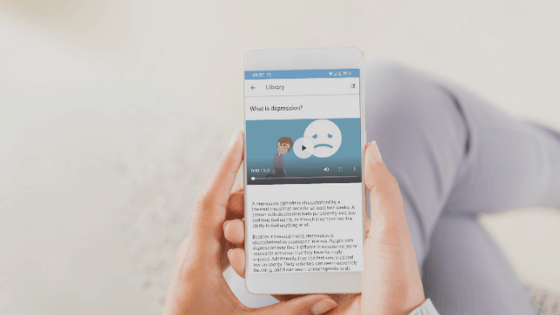
Getting started with mHealth technology for mental health

Getting started with mHealth technology for mental health

Getting started with mHealth technology for mental health can seem like a daunting process even though it has proven to bring many benefits to medical practice such as improving medication adherence, increase patient engagement and improve health outcomes in a cost-efficient way.  Therefore, the sooner healthcare providers embrace this technology, the better.

Luckily, mHealth technology does not only offer benefits for patients, but it also solves many of today’s healthcare challenges, since it provides healthcare providers with the scalability to treat more patients with fewer resources.

In spite of the clear benefits, many healthcare providers, have not yet fully embraced mHealth technology due to several reasons:

  • Lack of budget
  • Uncertainty about choosing the right tool
  • Uncertainty about the ease-of-use
  • Uncertainty if it will, in fact, make a difference

Luckily, Monsenso is committed to helping healthcare providers overcome these obstacles.

Lack of Budget: A lack of budget may seem like the largest impediment to acquiring digital health tools. However, this type of tool should be considered as a valuable investment, since it enables providers to treat and monitor more patients with fewer resources. Besides, all healthcare professionals may have access to the same patient data even when their main practitioner is not available.

Uncertainty about choosing the right tool: Choosing the right tool may be confusing because the functionality greatly varies among the different suppliers. One thing is certain, providers need to choose an mHealth solution rather than a health app since the later does not allow information-sharing between patients and providers. Other criteria should include looking for a solution that is technically and clinically validated, is well-established in the market, and it holds relevant certifications such as the one given to the medical device companies, CE Mark and other ISO certifications.

Uncertainty about the ease-of-use: UI and UX have evolved considerably during the last few years, therefore the product development team of any serious company offering an mHealth solution, will take into consideration these principles to ensure the product provides a meaningful and relevant experience to users in terms of design, usability and function. It is as simple as booking a product demo or requesting a free trial to ensure that the desired solution is intuitive and easy to use for doctors and patients alike.

Uncertainty if it will, in fact, make a difference: Perhaps, this may seem the hardest obstacle to overcome. Would this thing actually work? Although no one can guaranty if a tool will work for a specific medical practice, there is a precedent that this technology actually works. According to a recent study conducted by McMaster University, online therapy can be more effective than in person. You can also read third-party validations to give you confidence in your choice.

mHealth solutions can improve health outcomes in a cost-efficient way

mHealth solutions can improve health outcomes in a cost-efficient way

MHealth solutions can improve health outcomes in a cost-efficient and scalable way. They assist healthcare professionals with the management and documentation of medical records, help improve productivity and allow access to information.

These tools also help healthcare professionals to communicate findings and reduce error rates, not to mention the reduction of overall healthcare costs. Mobile solutions can also facilitate the treatment process, automate management systems and manage patient experience.

They use sophisticated data analytics and mobile technologies to help provide the best care possible, at a lower cost, anytime, anywhere. Cloud-based solutions are gaining prominence as data is stored on the internet for easy access, removing the need for storing the data locally. New mobile applications integrate patient data with geo-location information stored on the cloud.

Mobile apps facilitate better and easier health management through simple applications like exercise trackers, diet, and calorie-counting, among others.

Now more than ever, due to budget constraints and a shortage of qualified personnel, healthcare providers are looking for new ways to reduce administrative processes, improve productivity, and enable clinicians to spend more time on patient care rather than processing paperwork. With this in mind, organisations are looking into migrating from paper-based to paperless systems.

Mobile data-capturing solutions are beneficial for healthcare professionals and patients alike since they improve workflows and enable clinicians to spend more time seeing patients.

MHealth solutions enable healthcare professionals to access patient information more efficiently, ensuring patients receive better care, even if their primary clinician is not available.

Furthermore, communities are looking to form multi-sector collaborations that support their ability to better understand and tackle the social determinants of health. There is a growing need to build capacity beyond the healthcare sector and to find new ways to integrate data from multiple areas to improve community health.

MHealth solution help provide coordinated care

For people with complex health issues, such as those with a severe mental illness, the coordination of medical and community services can significantly improve their quality of life.

These individuals often require the most costly treatment and care. Therefore, many communities are aiming to link the available data between social services and clinical services to provide more comprehensive care.

Using aggregated data to improve community health

Linking aggregated data from different sources may reveal information about a particular population group, enabling healthcare providers to develop a more comprehensive understanding of the health factors in a specific community.

 Measuring health at a more detailed level allows decision-makers from the public healthcare system to recognise differences, plan more effective interventions, and monitor a particular group over time.

MHealth solutions enable the re-use of research health data to drive healthcare initiatives

Academic institutions and non-profit organisations continuously conduct research on specific patient-groups. Since these organisations collect and analyse health-and-behavioural-related data on vulnerable populations, this data could be re-used to address related issues and to drive new healthcare initiatives and policies.

 In addition to these points, data encryption ensures that all patient information is kept strictly private and protected at all times. International laws require that every organisation accessing patient information should adhere to strict confidentiality conditions.

Reference:

Mobile Health (mHealth) Market – Industry, Trends, Opportunities and Forecasts.

Research project HedaX aims to develop a new platform to securely handle health data

Research project HedaX aims to develop a new platform to securely handle health data

Copenhagen Demark – 22 June 2020. The Research Project HedaX received EUR 16 million from the Danish Innovation Fund to develop a digital platform that can securely collect and exchange health data. This tool will provide researchers with the basis to offer better, personalised medicine.

In the current world situation, the proliferation of a new virus has had fatal consequences for society. However, the spread of infection can be curbed by collecting and exchanging data; this data exchange needs to take place without compromising an individual’s privacy. The Research Project HedaX aims to develop a digital solution that collects and exchanges personal health data anonymously and securely.


THE DANISH RESEARCH PROJECT HEDAX HAS A SOLUTION

The Research Project HedaX project will initially test the solution in two pilot projects that involve 1,000 cancer patients and 1,000 people with bipolar disorder. The goal is to use this new health data to gain insight into how the treatment is helping patients, and to demonstrate that sharing personal health data can help develop better-personalised care.

The Research Project HedaX involves ten public and private partners that will work together to develop a platform that ensures health data is securely collected and exchanged between individuals, healthcare professionals, and researchers.

The data collected by the solution would include an individual’s medical history, medication compliance, and personal sensor data, which is the data collected by most fitness apps.

The analysis of this data should provide a basis for better and cheaper treatment in the form of personalised medicine.  The platform should also be used to monitor the spread of an infection confidentially, so that it is possible to identify where the infected individuals are located, without knowing who they are.

The newly developed platform should include the latest and most secure data encryption from various sources, such as the individual’s mobile phone, to the Social Security Registry and government’s databases.

Individuals should be able to get an overview and insight into the data that is being used, the entity using the data, and its purpose.

The Monsenso mHealth solution will be used to collect objective and subjective data from 1,000 individuals with bipolar disorder. The data will be anonymised and incorporated to the Registry data and EMR data to provide a new foundation for deep phenotyping, personalised medicine and overall understanding of real-life drug effectiveness.

“During the past five years, the Monsenso mHealth solution has been used in different research projects around the world to securely collect and share data between individuals with a mental illness and their healthcare professional. The scope of the project is rather familiar to us, and we are looking forward to participating in this project and helping individuals maintain their privacy while their data is safely collected and used to improve future treatments,” says Thomas Lethenborg, CEO of Monsenso.


The HedaX partners:

Secata is a pioneer in the commercial application of advanced encryption for data sharing. Their technology is based on more than 20 years of groundbreaking research in secure multiparty computation.

The Data for Good Foundation is a newly established foundation with non-profit purposes, based on GDPR legislation, that helps individuals share and retain control over their data.

DataFair is an entrepreneurial company with a particular focus on data-driven innovation and personalised medicine based on Denmark’s reliable health data.

The Alexandra Institute works with applied research in the field of digitisation and has helped develop encryption technology within the health sector.

The Danish Cancer Society is Denmark’s largest patient organisation.

Lundbeck is a Danish pharmaceutical company working on the development of pharmaceuticals within psychiatry and neurology.

Monsenso is a Danish company that develops mobile health solutions that help individuals collect information on their mobile phone to use it for prevention and treatment.

The Danish Capital Healthcare Region (Region H) offers Monsenso’s solution to patients within psychiatry.

DPO Management advises on secure and confidential sharing of data with a focus on GDPR rules.

Clinical Epidemiological Department at Aarhus University works with analysis of health data.

To read the Danish version, click here. 

For additional information contact:

Jennifer Highland
Marketing Consultant
marketing@monsenso.com
Monsenso

Improve the way you work with your mental health patients

Improve the way you work with your mental health patients

Mobile health technology can be used to support important decision making in diagnosis and treatment, especially in the field of mental health. It can empower patients by involving them in their own treatment and by providing them with the tools needed to help them manage their own disorder. Monsenso is leading the way in making technology an integral and useful part of mental health treatment.

. . . . . . . . . . . . . . . . . . . . . . . . . . . . . . . . . . . .

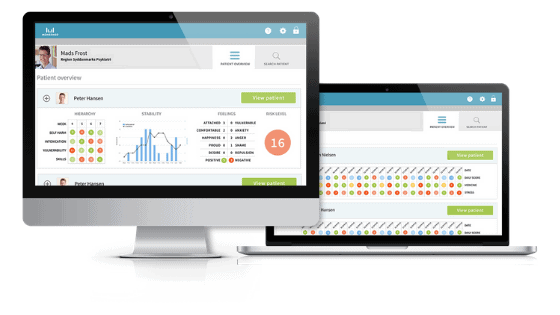
Imagine a session with your patient in which you have an overall picture of their mood, sleep, and medication adherence and can ask questions relating to their current mental state.  You can view patient self-assessment data that will give you a better idea of how they have been doing day-to-day, giving you a better understanding of their mood over time. With this, your questions in the session can be more relevant, and you can more quickly identify important topics.

What you just read is a possibility when taking advantage of today’s technology. In the Monsenso app, patients are asked to fill out a quick, daily self-assessment or weekly questionnaires. They may for instance be asked to rate their sleep, mood or activity. They will be able to follow their own progress and become more aware of how the choices they make impact their mental state. What is more is that you can see exactly what your patients input through accessing the clinical web-portal. This knowledge can help you in the process of diagnosing or finding the most effective medication for an individual more quickly. Clinicians using the system say that the solution can be compared to a “mental X-ray,” which may even allow you to do early interventions, as you can see which patients are beginning to experience a negative state or even a relapse.

One healthcare professional who uses the Monsenso solution says: “During conversations with my patients, I always start with the data in the system. It is a great icebreaker that allows me to skip asking certain questions. Now, our conversations are facilitated by the information available in the system.”

The Monsenso solution empowers patients to be more involved in their own treatment. In between sessions they may use relevant features when they are facing a challenging situation, whether it is restructuring negative thoughts using our mobile CBT thought feature or learning more about their disorder or treatment plan in the psychoeducation library.

A patient living with bipolar disorder finds the solution beneficial in managing their disorder: “It made me more aware of how my sleep pattern influences my mood. In my life with this disorder I see myself as a tightrope walker, and this metaphor for living with bipolar disorder is very meaningful. You have to prevent losing control either to depression or to mania. You are able to avoid that by earlier registration on how your mood is fluctuating, so therefore the app helps to keep you in control of your life…”

We believe it is time for technology to ease the burden on clinicians and provide opportunities that are not available when everything is handled in the old paper-pencil way. If you too think technology needs to become more widely used in the treatment and is ready to embrace it, Monsenso will be there helping you all the way.

Transforming healthcare with technology-enabled care

Transforming healthcare with technology-enabled care

Connected health or technology-enabled care (TEC) is the collective term used for telecare, telehealth, telemedicine, mHealth, digital health, and eHealth services. TEC is now seen as a fundamental part of the solution to solve many healthcare challenges.

TEC helps people self-manage their health and wellbeing, alert healthcare professionals in case of any changes in an individual’s condition and support medication adherence.

It also helps clinicians and care providers deliver more efficient and cost-effective care.

Digital technology is advancing exponentially, and its cost is becoming more affordable. The need for more cost-effective healthcare is rising. Now more than ever, healthcare authorities need to adopt new technologies to help meet this demand.

Key trends

An aging population

The population is increasing, and people are living longer. These two factors, in addition to a rise in chronic conditions, present new healthcare challenges.

In the United States, population projection reports that older adults currently make up about 15% of the population, and by the year 2060 is estimated to amount to 23.5%.

There are similar numbers reported for Europe, where the group of 65-year old or older make up 19% of the population and is predicted to amount to 29% of the total population by the year 2080.

Use of mobile devices is increasing amongst all age groups

A 2019 report conducted by Provision Living, a senior living community in the U.S.,  revealed that on average, Baby Boomers (born between 1946 and 1964) and millennials (born between 1981 and 1995) spend on average, five hours a day on their smartphones.

Smartphone adoption among Americans:

  • Aged 50 to 59 is 86%
  • Aged 60 to 69 is 81%
  • Aged 70+ is 62%

Other market drivers

The demand for apps and wearable devices is also being driven by an increased focus on personalised care. Large pharmaceutical companies are now using apps and wearables to gather valuable health-related patient data, support their research, and provide an holistic service to patients.

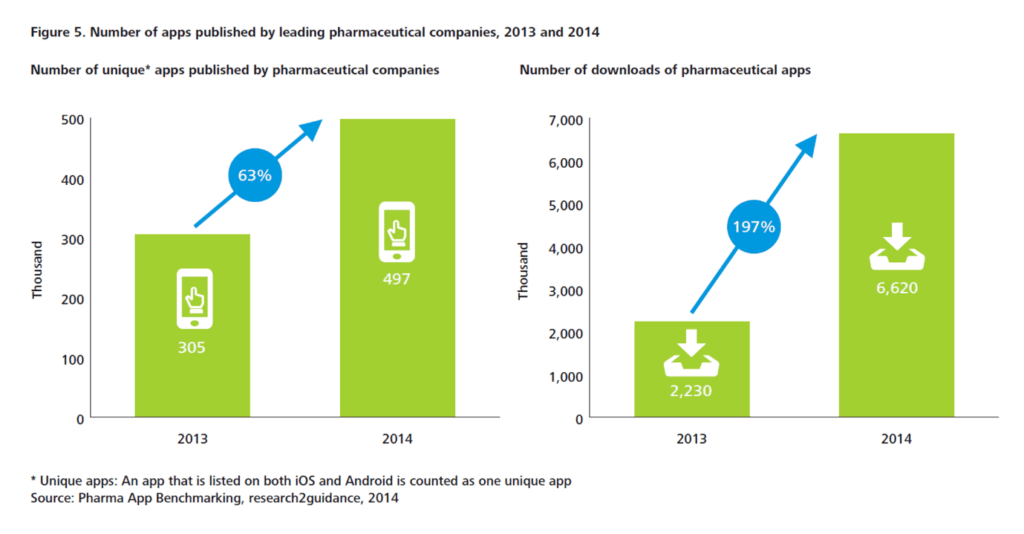
In 2014, the leading pharmaceutical companies had an increase of 63 % in unique apps compared to 2013. In just one year, the total number of downloads of pharmaceutical apps increased by 197% as shown in Figure 1. These apps deliver education and training, can titrate medication and monitor compliance.

Figure 1. The number of apps published by leading pharmaceutical companies, 2013 and 2014.

There has also been an increase in online patient communities, using social media as a platform to exchange experiences with patients and carers.

Increasing patient trust in health apps

There is strong evidence that patients are now more than ever concerned about self-care, and they are interested in boosting their health and wellbeing. In addition to this, health technology companies are working to improve the quality of apps, increase user confidence and trust, and launch informed decision-making in app selection for health professionals, patients and the public.

Agencies like the US Food and Drug Administration (FDA), or NHS Choices and its NHS Health Apps Library have developed criteria that judge apps for safety and technical proficiency. For example, for apps to be included on the NHS Choices search website, which in early 2015 lists around 150 apps, they must be reviewed by a technical team (testing relevance, legal compliance and data protection), then by a clinical team (to test scientific rigour).

PatientView is an independent organisation that has developed a systematic method of appraising health apps. Until April 2015, there were 363 apps recommended for the Apple platform and 236 for Android, with smaller numbers recommended for use on other platforms.

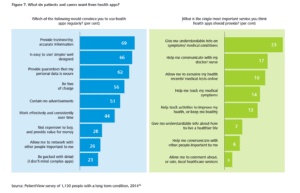
In 2014, PatientView undertook a survey of 1,130 patient group members to identify what people want from health apps as shown in Figure 2.

Figure 2. What do patients and carers want from health apps?

References:

Connected Health: How Digital technology is transforming health and social care. Deloitte Health.

Forget Generational Stereotypes, Baby Boomers Are Just As Addicted To Smart Phones As Millennials. 

Older Adults Keep Pace on Tech Usage.

An Aging Population, Larger Chronic Disease Burden, and Reliance on Digital Self-Management Tools Require Contributions from Nurse Informaticians.