Interested in using mHealth technology but don’t know how to start?

Interested in using mHealth technology but don’t know how to start?

On a previous blog post, we established that patients value mHealth technology; therefore, the sooner healthcare providers embrace this technology, the better.

Fortunately, mHealth technology does not only offer benefits for patients, it also solves many of today’s healthcare challenges, since it provides public and private healthcare providers the scalability to treat more patients with fewer resources.

Nevertheless, in spite of the clear benefits, most healthcare providers, have not yet fully adopted mHealth technology due to several reasons:

  • Lack of budget
  • Lack of awareness of the benefits of using the technology
  • Feeling overwhelmed on the increasing amount of health apps available
  • Fear of the amount of time needed to learn to use the new technology
  • Strong belief that patients’ lack of the necessary knowledge to use the technology

Fortunately, our mHealth solution can help you avoid these obstacles. Here’s how:

  • Lack of Budget: 
    • A lack of budget may seem like the largest impediment to acquiring digital health tools and necessary technology. However, this should be considered as a valuable investment.  One of the most tangible benefits of using portable, real time updated, mobile health technology is its consistent availability for patients and clinicians. Our mHealth solution synchronises the data from the patient’s smartphone to the clinician’s web portal in real time. Patients can feel connected to their treatment and their clinician beyond scheduled sessions. mHealth technology can ultimately record more data and information regarding the patient’s progress than old pen and paper methods, and provide availability and support for the patient when the clinician cannot physically be there. A more informed treatment can save time and resources for patient and healthcare alike.
  • There are several benefits to using our technology that you may have not known of:
  • Another barrier that healthcare professionals may face is the selection of the right mHealth solution.
    • Although there are currently 165,000 mobile health apps on the market, the selection does not have to be daunting. A good way to begin this selection is by identifying and specifying what types of disorders you would like assistance with from your mHealth app.  Another way to narrow down the selection is through the identification of the mHealth solutions that possess quality stamps (such as CE Marks and ISO certifications) as well as a clinical validation. In order to obtain the certification, these solutions must have passed a set of agreed upon standards for medical devices that cover data security management and quality of material.
  • Interactive and consistent support: 
    • We understand that using technology can be frustrating and difficult, which is why at Monsenso we offer several ways to get help from real people – instead of an automated service.  We offer an interactive support portal and dedicated customer support team, as well as a detailed user guide.

Still have questions about mHealth? Feel free to contact us or leave us a comment below.
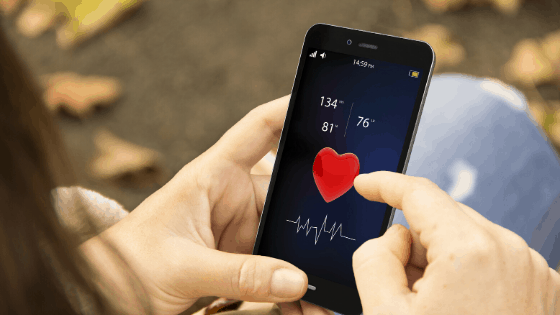
mHealth tools can increase patient engagement

mHealth tools can increase patient engagement

There are now 318,000 mHealth apps available in the market, that number has nearly doubled since 2015 driven by increased smartphone adoption and ongoing heavy investment in the digital health market. The global mobile health (mHealth) app market was estimated at $28.5 billion dollars in 2018 and is expected to reach $102.35 billion dollars by 2023. Health-related mobile applications and technologies are often known as mHealth and manage patient experiences.

A survey conducted every year from 2017 to 2019 by Rock Health revealed that:

  • 44% of the respondents tracked a health indicator using a digital tool in 2019, an increase from only 33% in 2017
  • 56% of the respondents shared health tracking data with their physicians in 2019, in comparison to only 46% on 2017

This integration of patient-collected data into patient-provider discussions represents an opportunity to use mobile technology to increase patient engagement and patient empowerment.

The impact of digital tracking tools is the greatest when such tools drive a positive behavioural change, incentivising the user to change the habits that impact their health outcomes, such as in the case with mental illness. This is called a “trackable condition, ” a situation in which a person is diagnosed with a condition that improves by tracking and altering relevant behaviours such as sleep, exercise, mood and medication compliance.

Recent research conducted by McMaster University revealed that cognitive behavioural therapy that connected therapists and patients through such modes as web-based applications, video-conferencing, email and texting, improved patients’ symptoms better than face to face.

A different survey conducted by Technology Advice stated that patient engagement through mHealth tools is one of the defining trends in U.S. healthcare.

The survey disclosed that:

  • 80% of patients say that digital services play an important role when choosing a physician
  • 60% of patients feel it’s important for a physician to follow up with them after an appointment
  • 80% of all patients would like to view their results and diagnosis online

Not surprisingly, 60% of millennials support the use of telehealth and 71% would like for their doctor to use mobile applications. However, young people are not the only ones embracing this type of technology. A senior health and technology survey revealed that over 90% of seniors have a health improvement goal and want to use mHealth tools to achieve it.

In spite of this growing trend, many healthcare providers have not yet fully embraced this technology, even though it is very important for patient engagement, and it is now seen as a vital part of the solution to solve many healthcare challenges. MHealth tools can help people self-manage their health and well-being, alert healthcare professionals in case of any changes in an individual’s condition, and support medication adherence. This technology also helps care providers deliver more efficient and cost-effective care. Now more than ever, healthcare authorities need to adopt new technologies to help meet these challenges and to keep up with their patients’ demands.

MHealth technology is here to stay, and healthcare providers can reap the benefits and build a better relationship with their patients sooner rather than later if they take the time to learn more about the different solutions available out there. For example, a good way of selecting an mHealth solution provider is by taking into consideration a manufacturer’s technical and clinical evaluation studies, randomised clinical trials. It is also important to look out for quality stamps such as CE Mark, ISO certifications and medical device certifications.

The Monsenso solution is a clinically-validated, CE Class I Marked mHealth solution classified as a Medical Device, consisting of a smartphone app for patients and web portal for healthcare providers that is widely used in the prevention and treatment of common behavioural disorders such as depression and anxiety. It can also be configured to prevent and treat severe mental illnesses such as bipolar disorder, borderline personality disorder, PTSD and schizophrenia. It is currently being used by over 1,000 patients across the globe and is highly valued by patients and healthcare providers.

References:
Mobile Health (mHealth) App Market – Industry Trends, Opportunities and Forecasts to 2023
Rock Health Survey 2017-2019

Monsenso’s IPO offering was oversubscribed by 238%

Monsenso’s IPO offering was oversubscribed by 238%

Copenhagen Demark – 3 June 2020. Monsenso A/S today announced the result of the new share offering in connection with the IPO on Nasdaq First North Growth Market Denmark.

Monsenso’s IPO offering was oversubscribed by 238%, which means that the company offer of DKK 16-20 million new shares was extremely well received by both professional and private investors, which together have subscribed for DKK 47,504,123, corresponding to the maximum offering.

The subscription period closed on 29 May 2020 at 23:59 hrs. CEST time. The company’s offering of up to 3,773,585 shares, at a price of DKK 5.30 per share has come to an end and will provide the company with gross proceeds of DKK 20 million and result in a market cap of DKK 70.04 million.

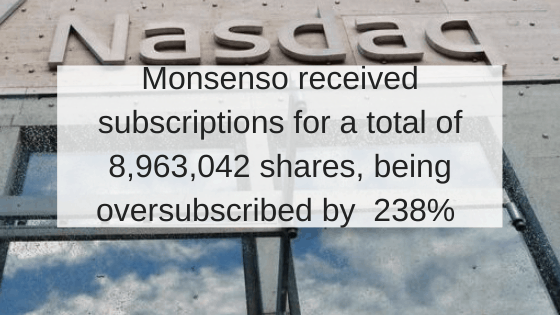
Monsenso received subscriptions from 2,219 investors for a total of 8,963,042 shares corresponding to the offering being oversubscribed by a total of 238%.

The first trading day on Nasdaq First North Growth Market Denmark is expected to be on 10 June 2020.

CEO Thomas Lethenborg, Monsenso said:

“The IPO offering was very well received by professional and private investors, including great participation in our online investor meetings. We have now received the necessary funding to strengthen our sales efforts, customer support, and to further develop our mHealth solution for mental health. We now have to live up to the trust and expectations coming from our 2,219 new shareholders. We look forward to being a listed company and welcoming the continued support from our many new shareholders.”

Summary of the Offer:

  • Monsenso issued 3,773,585 new shares at a subscription price of DKK 5.30 per share, which gives gross proceeds of DKK 20.0 million
  • Based on the offer price, Monsenso’s market cap is now DKK 70.05 million
  • Free float (the proportion of the share capital owned by the new shareholders) is 27.05%
  • Due to the great interest in the offering, all orders up to and including DKK 150,000 have been allocated 720 shares plus 20% of the number of shares subscribed for in addition to the 720 shares
  • All orders over DKK 150,000 have been reduced individually based on the company’s assessment
  • All pre-offering subscribers have received a full allocation.

For additional information contact:

Thomas Lethenborg
CEO Monsenso
lethenborg@monsenso.com

What Is the difference between a health app and an mhealth solution?

What Is the difference between a health app and an mhealth solution?

Over the past few years, mHealth solutions have begun to solve some of the problems that are ailing healthcare. MHealth is paving the way for better data management, doctor-patient communication, reduced hospital admissions, medication adherence, and remote patient monitoring. 

MHealth solutions are improving outcomes in measurable, repeatable ways by connecting patients with their doctors.

In 2017 mHealth captured $23 billion in revenues, with an estimated growth rate of 35% annually over the next several years.

What is the difference between a health app and an mHealth solution?

Health apps are application programmes that offer health-related services for smartphones, tablets, PCs, and other communication devices.

The most popular categories of health/wellness apps are: 

  • Sports and fitness activity tracking
  • Diet and nutrition
  • Weight loss coaching
  • Medication tracking
  • Sleep cycle
  • Stress and relaxation
  • Meditation
  • Menstrual period tracking
  • Pregnancy
  • Hospital selection and appointment tracking

Health apps can provide valuable information to users. However, it may be hard to determine the accuracy of the information provided and may not be easy to share this data with the user’s doctor.

MHealth or mobile health refers to the practice of medicine and public health supported by mobile devices such as mobile phones, tablets, personal digital assistants and wireless infrastructure. It encompasses all applications of telecommunications and multimedia technologies for the delivery of healthcare and health information.

Why is mHealth used?

  • Provides education and awareness
  • Assists with diagnostic and treatment support
  • Enables remote data collection
  • Facilitates remote monitoring
  • Enables telemedicine
  • Supports chronic disease management
  • Support medication compliance

Numerous mHealth initiatives across the world have demonstrated the efficacy of using mobile devices to deliver better care in a cost-effective manner.

Many mHealth solutions offer different types of information sharing, such as data collection through patient self-assessments, electronic questionnaires, and sensor data. They can also offer emergency action plans and an encrypted messaging system that allows direct communication with the clinic.

Besides, many mHealth solutions are considered certified medical devices that have a proven record of helping healthcare professionals in the monitoring and treatment of their patients.

Both, health apps and mHealth solutions can both be used on-the-go. However, the main difference is that health apps are for consumers-only and mHealth solutions improve the collaboration between patients and healthcare professionals.

References:

mHealth (Mobile Healthcare) Ecosystem Market: 2017-2030 – $23 Billion Opportunities, Challenges, Strategies & Forecasts.

Health apps definition.

What is mHealth?


Big Data in treating mental disorders

Big Data in treating mental disorders

Big data in treating mental disorders explains how data is transforming the treatment of mental disorders and the overall life science industry. Monsenso’s mHealth solution shows how technology provides new ways to inform treatment and achieve scalability. This is a blog post written by Mads Frost PhD, Co-founder and Chief Product Officer of Monsenso. 

The challenge with mental health today

According to numerous analyses and forecasts conducted by several international organizations and authorities, mental health today is one of the biggest challenges for society and health budgets. In fact, the World Health Organization (WHO) has predicted that mental disorders will be the greatest health burden for society in the coming years. This emphasizes the need for solutions to remedy this. Presently, technology is the best bet.

An example of the utilisation of technology to help overcome the burden of mental health for society is Monsenso. Monsenso is an innovation leader in mHealth solutions for the treatment of mental disorders. Monsenso helps support the treatment of mental disorders by inspiring and strengthening cooperation between patients and therapists.

Based on continuous research with leading experts in psychiatry, pervasive healthcare and data science, Monsenso has designed an innovative solution that fits into each patient’s life and helps them to better manage their disease as well as increasing the quality and effectiveness of treatment. It has been developed in a user-centred design approach, with patients, clinicians and relatives, to ensure that the solution is easy to apply and fits into the patient’s life and treatment.

The mental x-ray

Through daily self-assessment, clinical questionnaires, and collection of behavioural data from both sensors in modern Smartphone, wearables, and even voice analyses of patients’ voices, Monsenso provides the patient and the therapist with a detailed insight into the user’s mental health state. Through the application of advanced data analysis, indicators such as behavioural patterns, contexts and even forecasting future conditions and risk levels can be demonstrated – all with the purpose of gaining better insight into the patient’s mental health and providing an improved basis for treatment.

Generally, many organizations are fighting to realize mHealth’s full potential. According to a study where clinicians have been asked: “What is your most pressing information technology problem”, the answer that received the highest percentage of responses was, “turning data into action.” [1]

Psychiatry has previously used paper schemes to collect information from patients. However, but current technology provides access to a wide range of information that has not previously been available. This technology can be called the mental x-ray, in that using this technology can be used to see and monitor mental functioning with x-ray like precision and detail. This allows for early interventions and to help patients when they are in need. An example of this at work is the Monsenso based research into using voice analysis as an objective state marker for bipolar disorder . [2]

Paradigm shift in treatment: How do we achieve scalability?

To achieve the benefits of technology, it is necessary to adapt the clinical workflows. Psychiatry has a very traditional form of treatment where the patient meets the therapist and receives face-to-face treatment. The future brings more patients and fewer therapists – how do we scale this?

One possible solution is to optimising treatment is to use monitoring systems. These systems can rapidly identify which patients are in need of help, and which ones are well. In this way, clinicians’ time can be focused on patients who are in need.  Likewise, the systems can be more treatment-supporting, taking over the trivial and automatable tasks of the clinician, allowing them to spend their time on those with the greatest needs – the complex cases that technology cannot help. The last perspective – a paradigm shift in treatment – is to go from a reactive to a proactive approach. The proactive approach comes from gathering more detailed information, to lead to more informed decisions and earlier interventions. More information can help immediately notify both patients and clinicians when things start to go in the wrong direction, and need help to prevent potential hospitalisations. And the patients, who are well, can focus on life and not illness. However, it is important to keep in mind that it is not a trivial task to realise this.

How should we realise the potential of ‘Big Data’

On an overall level, there are a number of points that companies that are active in data-driven health technology should think about to thrive in complex health environments:

  • Find applications and services that bring tangible value to identifiable stakeholders – it must provide meaning and value to end users
  • Think on a global scale
  • Focus on solutions, not technology
  • Identify potential partners to create greater impact and find new value

Most of all, those who come from the outside into the healthcare domain must avoid the trap of seeing technology as something different from healthcare. Its greatest value will be how it integrates with healthcare systems and allows clinicians to provide better care for patients.

In some cases, technology will appear illusory: Personal contact between patient and therapist will always have a place in treatment, but data driven approaches can revolutionise the basis on which treatment is given.

Where are we going?

There are many possibilities that presents itself when exploring data driven approaches. I have  particularly emphasised ‘Context Aware Computing’ as one of the perspectives that are important to pursue. The goal is to use the context of the patients to provide the right intervention, to the right patient, at the right time, at the right place. This is not a trivial task, but extremely important for solutions like Monsenso to really help patients. The present systems are still relatively unintelligent in terms of achieving this, based on the amount of data available. It is difficult to know the context of what the collected data in the system is based on – what experiences and thoughts the patients have.

[1]  Top 5 industry challenges of 2016 By Aubrey Westgate, November 30, 2015  http://managedhealthcareexecutive.modernmedicine.com/managed-healthcare-executive/news/top-5-industry-challenges-2016?page=0,0

[2]  VOICE ANALYSIS AS AN OBJECTIVE STATE MARKER IN BIPOLAR DISORDER. M Faurholt-Jepsen, J Busk, M Frost, M Vinberg, EM Christensen, O Winther, JE Bardram, and LV Kessing. Translational Psychiatry, 2016. (ISSN: 2158-3188) (DOI: http://dx.doi.org/10.1038/ tp.2016.123), vol: 6, issue: 7, 2016