Mar 26, 2017
The MONARCA II Research Project aims to establish clinical evidence on the use of the Monsenso system. The MONARCA II trial uses a randomised controlled single-blind parallel-group design.
Mental illness
Approximately 25% of all people in Europe and the US experience a mental illness at least once in their lifetime. Currently, the monitoring of mental illness relies on subjective clinical self-reporting rating scales, which were developed more than 50 years ago. The EU-funded MONARCA project established a platform for the daily electronic monitoring of subjective and objective measures of illness activity in bipolar disorder using smartphones. The system supports the treatment of bipolar disorder by collecting (i) self-rated (‘subjective’) data on parameters like mood, stress, and cognitive problems, and (ii) automatically sensor-based (‘objective’) data the patients behaviour in terms of mobility (GPS), physical activity (accelerometer), social activity (telephony and texting), and general phone usage. This data is captured and forwarded to a server, where it can be accessed, visualised, and monitored by the clinical staff and applied for clinical decision support. The MONARCA system is now further developed and supported by Monsenso.
Monsenso’s involvement in the The MONARCA II RESEARCH PROJECT
Patients with bipolar disorder according to ICD-10 who previously have been treated at the Copenhagen Clinic for Affective Disorder, Denmark are included and randomised to either daily use of the Monsenso system including a feedback loop between patients and clinicians (the intervention group) or to the use of a smartphone for normal communicative purposes (the control group) for a 9-month trial period. The trial started in September 2014.
The outcome measures between the intervention group and the control group are:
- Differences in depressive and manic symptoms; rate of depressive and manic episodes (primary);
- Automatically generated objective data on measures of illness activity; number of days hospitalised; psychosocial functioning (secondary);
- Perceived stress; quality of life; self-rated depressive symptoms; self-rated manic symptoms; recovery; empowerment and adherence to medication (tertiary)
- Ethical permission has been obtained. Positive, neutral and negative findings will be published.
If the system is effective in reducing depressive and/or manic symptoms (and other symptoms of bipolar disorder) and the rate of episodes, there will be basis for extending the use to the treatment of bipolar disorder in general and in larger scale.
To read more download the research paper:

Mar 26, 2017
The RADMIS Research Project is supported by the Innovation Foundation in Denmark and is done in collaboration with the “MONARCA team” with the department of psychiatry represented (RHP) by professor Lars V. Kessing and DTU represented by professors Jakob E. Bardram and Ole Winther.
Depression and bipolar disorder
According to WHO, depression and bipolar disorder are leading causes of disability worldwide, and they cause a high burden in terms of cost, lost productivity, morbidity, suffering, and mortality. According to the European Commission, depression is one of the most pressing public health concerns today, accounting for more than 12% of all estimated ill health and premature mortality in Europe, only exceeded by heart disease and cancer.
Although during the last few decades, psychiatric treatment has shifted more from inpatient treatment to outpatient treatment, the costs of psychiatric hospitalisations are still significant.
In fact, patients with affective disorders are more frequently hospitalised than any other patient group, counting for approximately 20% of all psychiatric hospitalisations.
Monsenso’s involvement in the RADMIS RESEARCH PROJECT
Monsenso is responsible for improving and developing four modules in the Monsenso mHealth solution.
1. Data-collection framework. This task will research and develop a framework for data collection, clustering, preprocessing, and management based on both patient self-reporting and automatic sensor data collection. This will be done as part of the Monsenso platform with input from DTU research on data preprocessing and pathological insight from RHP.
2. Context-aware CBT module. This task will research and develop a module for context-aware (just-in-time) delivery of a rumination-focused CBT and (b) concreteness training, a facilitated self-help intervention intended to increase specificity of processing in patients with depression. This will be done as part of the Monsenso platform with design and technical input from DTU and psychological insight and input from RHP.
3. CBT content. This task will develop multimedia content for CBT training, such as action and coping plans for patients, cartoon and video instruction material, and medication guidance. This content will be developed by psychologist from RHP and incorporated into the CBT module.
4. Illness-forecasting module. This task will research and develop a module for disease forecasting based on research from DTU on correlations analysis and prediction. This module will be included into the Monsenso platform.
To learn more read:
Mar 20, 2017
mHealth offers the opportunity to offer scalable and cost-effective mental healthcare. One of the greatest challenges the healthcare systems face is the long-term care of individuals with severe mental disorders such as schizophrenia since the impact this has on individuals, families and societies is huge. Fortunately, some of these issues can be partially solved with the use of mHealth technology. Besides, the advantages of online therapy are many, including a more personalised treatment, patient-empowerment, teaching self-care and helping people who wouldn’t receive treatment otherwise.
Schizophrenia has an estimated point prevalence of 0.4% and a lifetime risk of 1%, which means that 1 in every 100 people will suffer from schizophrenia during their lifetime. It is the 7th most important illness in terms of years lived with disability, accounting for 2.8% of disability caused by all illnesses. For people aged 15 to 44 years, it is the 3rd most important disease, accounting for 4.9% of disability resulting from all illnesses.
During the last few decades, the European Union has made a huge effort to overcome these barriers and to ensure high-quality, longer-term care for people with severe mental disorders. These efforts started in the 60’s with the development of new pharmacological treatments for psychosis, which radically changed the prognosis of severe mental illness. In the 70’s and the 80’s, there was an emergence of new psychosocial interventions and new concepts of mental health care organisations [1].
Nowadays, there is a need to shift the health care model. The transition from traditional large psychiatric institutions to modern comprehensive community-based models of care, including acute patient units at general hospitals [1].
According to a report published by EU, this shift is necessary due to the following reasons:
- Accessibility to mental health care of people with longer-term mental disorders is much better with community-based services than with the traditional psychiatric hospitals
- Community-based services are associated with greater user satisfaction and increased met needs. They also promote better continuity of care making possible to identify and treat more often early relapses
- The community-based services protect the human rights of people with mental disorders and prevent stigmatisation of those people
- Studies comparing community-based services with other models of care consistently show significantly better outcomes on adherence to treatment [1]
However, European healthcare systems need to make lots of alterations if they want to provide accessible, effective, high-quality and long-term care to people suffering from severe mental disorders.
Challenges of the transition to new comprehensive community-based models of care
One of the main reasons why the development of long-term mental health services is insufficient is due to the lack of coordination between the different health services. A close coordination, and even joint funding and management of health and social care services is fundamental to cope with the new challenges European mental health systems are now facing. [1].
According to the report, these are the key principles to organise mental health services:
Accessibility: Essential mental health care should be available locally, including outpatient and inpatient care, as well as rehabilitative care. Local services provide continuity of care in a satisfactory manner.
Comprehensiveness: Mental health services should include all facilities and programmes required to meet the essential care needs of the populations.
Coordination and continuity of care: People suffering from severe mental disorders often find it extremely difficult to gain access to various basic services; therefore, it is crucial that services work in a coordinated manner. This coordination should also include services that are not directly related to health, such as social services and housing services.
Effectiveness: Service development should be guided by evidence of the effectiveness of particular interventions. For example, there is a growing evidence base of effective interventions for many mental disorders, among them depression, schizophrenia and alcohol dependence.
Equity: A person’s access to services of good quality should be based on need. It is quite often that the people who need these type of services the most are the least able to ask for help.
Respect for human rights: Services should respect the autonomy of persons with mental disorders, and encourage such persons to make decisions affecting their lives and treatment [1].
Scalable and cost-effective mental healthcare
The Monsenso mHealth solution does not only offer cost-effective mental healthcare, it can can facilitate five of the six points mentioned in the report to organise mental health services in an optimal way.
Accessibility: With mobile technology and telehealth, care providers can reach patients living in remote locations at a minimal cost. These technologies offer care providers more flexibility to deliver health care while on-the-go or from different locations—expanding the clinic’s service offerings [2].
Coordination and continuity of care: The Monsenso mobile health solution can facilitate and support the care of patients suffering from severe mental illnesses from community-based models. Due to its cloud-based model and unlimited scalability, patient records can be accessed by multiple organisations such as psychiatric institutions, general practitioners, and social services, among others.
Effectiveness and equity: With help of the Monsenso smartphone app, care providers can identify on a daily basis triggers and early warning signs of all patients in the system. With the Monsenso mHealth solution clinicians can prioritize caring for individuals who need immediate attention and continue to monitor individuals who are stable. According to the National Institute of mental health, early intervention is critical to treating mental illness before it can cause tragic results such as serious impairment, unemployment, homelessness, poverty, and suicide [4].
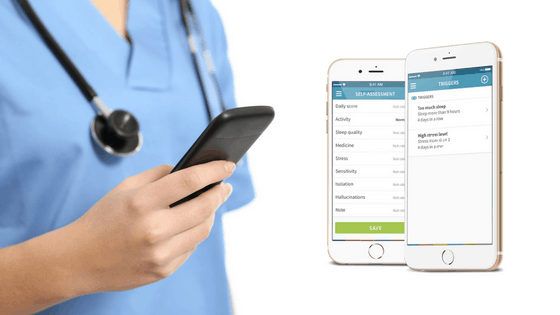
Respect for human rights: The Monsenso smartphone app enables patients to fill in daily self-assessments and write notes about how they feel. The information collected from these assessments is shared with the clinic, allowing individuals to be more involved with their treatment. The Monsenso smartphone app also provides individuals with customised action plans that act as guidelines in case their symptoms appear enabling individuals to take responsibility for their behaviours and actions.
References:
[1] The long-term mental health care for people with severe mental disorders. J.M Caldas de Almeida, H. Killaspy. Prepared under service contract with the Impact Consortium by the European Commission. 2011.
http://ec.europa.eu/health/mental_health/docs/healthcare_mental_disorders_en.pdf
[2] Increasing access to behavioural health care through technology. The U.S. Department of Health and Human Services Health Resources and Services Administration (2013, February).
http://www.hrsa.gov/publichealth/guidelines/behavioralhealth/behavioralhealthcareaccess.pdf
[3] Directors Blog: SAMHSA and NIMH partner to support early intervention for serious mental illness. P. Hyde and T. Insel. National Institute of Mental Health Blog (2014, June 17)
http://www.nimh.nih.gov/about/director/2014/samhsa-and-nimh-partner-to-support-early-intervention-for-serious-mental-illness.shtml
[4] Evidence based treatment for first episode of psychosis: Components of coordinated specialty care. PHD R. K. Heinssen. RAISE NIMH (2014, April 14).
http://www.nimh.nih.gov/health/topics/schizophrenia/raise/nimh-white-paper-csc-for-fep_147096.pdf

Feb 21, 2017
Using mHealth solutions for clinical trials as data-collection tools, can potentially revolutionise clinical research. Wearable devices and mobile health solutions can offer pharmaceutical companies access to additional patient data to provide a more comprehensive overview of safety and efficacy.
According to a new report by IMS Institute for Healthcare Informatics, there are now more than 165,000 mobile health apps on the market.
A report released in 2015 by Rock Health revealed that:
- 4 out of 5 internet connected adults use some kind of digital health technology
- 52% of consumers strongly agree that they are responsible for their own health
- 40% of people who made an online search for health information acted on the results of their search in some way
- 92% of users agree that they should be the one controlling their health data
- 80% of users would share their health data with their care provider to get better care [1]
The use of mHealth solutions for clinical trials is increasing, and according to industry experts, this trend will dominate the market in the coming years. In a recent SCORR Marketing report, 50% of industry experts surveyed say they use mHealth technology in their clinical trials and protocols, and of those 60% consider mHealth very important or critical to their research. [2]
As of August 29th, a search of clinical trials.gov showed 272 studies that mention the use of mHealth and 186 studies that mention a wearable. [2]
People use their mobile phones every day; it is the first and last thing they see when they wake up in the morning and before they go to bed. This is one of the reasons why the use of smartphones and wearables will continue to increase the use of mHealth solutions in clinical trials and pharmaceutical research.
The patient data obtained from mHealth devices, whether it is sensor or self-reported data, will transform the way patients are being diagnosed, monitored, and treated.
Additionally, the costs of conducting clinical trials are high, and mHealth technology has the necessary means to optimise the resources used and maintain lower costs. Mobile health data provides researchers with access to real-time data and visualisations that enable them to spot situations that otherwise would have been at best an indicator when reported through traditional clinical channels.
Additionally, pharmaceutical companies and researchers can immediately identify if a patient has stopped taking their medication or they present any unusual symptoms in real-time, and take action.
By using mHealth solutions, pharmaceutical companies expect to bring patients closer to the research and obtain better enrolment rates, compliance, and retention.
In addition to receiving information from patients, these devices can also be utilised to send information to the patients such as information about their condition and clinical questionnaires.
In the near future, pharmaceutical companies will be able to gather and visualise even more data in real time using mHealth technology, which will potentially shorten timelines, improve patient satisfaction, and increase future recruitment.
Interested in using mHealth technology for your clinical trial? Click here to learn more.
References:
[1] Rock Health: 80 percent of Internet-connected adults use digital health tools. J. Comstock. MobiHealthNews. (2015, October 19)
http://mobihealthnews.com/47675/rock-health-80-percent-of-internet-connected-adults-use-digital-health-tools
[2] MHealth in Clinical Research. Denise, Myshko. Pharma Voice. (2016, October)
http://www.pharmavoice.com/article/2016-10-mhealth/