Jul 5, 2018
In 1998, the Quality Chasm series was launched by the Institute of Medicine which included an informative report about delivering high quality healthcare. The report was entitled “Crossing the Quality Chasm: A New Health System for the 21st Century”.The strategies proposed in this report were to be used as an organizational model for a patient centered healthcare system, and to provide informative guidelines on how a healthcare delivery system can be redesigned to innovate and improve care.
This informative report uses six primary aims to achieve and implement high quality healthcare systems. Mobile Health solutions, such as our mHealth solution, can meet all of those six aims. See how below:


Apr 5, 2017
Telehealth for mental healthcare makes a lot of sense since mental health care is generally harder to access than other health services, due to a shortage of qualified mental health providers and coverage limits.
A report released by the U.S. Department of Health and Human Services Health Resources and Services Administration (HRSA) titled “Increasing access to behavioural health care through technology” suggests that to be able to reach a larger amount of people, organisations should consider the use of telehealth for mental healthcare.
Teleahealth for mental healthcare
The report mentions that broadly speaking, telehealth for mental health can take two forms:
- A caregiver such as a nurse or social worker can use telehealth technology to conduct a distance-based consultation with a mental health specialist to discuss how to handle a patient’s mental health needs
- A patient can participate in a videoconference session with a mental health specialist
The value telehealth for mental healthcare, was identified by HRSA safety net providers in terms of potential cost savings, efficiency, and expanded access to services. In general the HRSA report mentions the five main benefits of using telehealth tools for mental healthcare:
Improved care delivery
- Provide a more efficient patient care when they combine patient data with best practices in order to make care decisions. For example, in mental health, clinicians can review data and identify early warning signs for behavioral health concerns
- Facilitate the access, use and sharing of data and it supports the health system’s move toward collaborative and integrated approaches by strengthening relationships within a team and across agencies
- The patient-centered medical home (PCMH) model of care recognizes the value of care coordination supported by wireless technology
- Clinics can gain expanded access to experts, like mental health specialists, residing outside the local community. Telehealth can also ease the task of convening consultation sessions between primary care clinicians and behavioral health specialists
Expanded staff capacity
- Offer care providers more flexibility to deliver health care while on-the-go or from different locations—expanding the clinic’s service offerings
- Facilitates the hire of part-time, specialized staff who work remotely for multiple clinics
- Telehealth for mental health can be added to existing clinic operations. Thus, putting a team together is a matter of figuring how to make it work within the context of existing staff and budgets
Enhanced training opportunities
- Conduct trainings for staff when sessions are devoted to sharing of insights and best practices. These trainings can elevate expertise within an agency and across multiple providers
Cost savings
- Reduces the cost of care delivery. For example, if a patient suffers a relapse, telehealth enables a care providers to deliver counseling and intervention services quickly through teleconferencing sessions
Patient acceptance and engagement
- Works around patient fears over accessing services at a certain clinic or neighborhood. Health center patients are frequently reported to be either unable or unwilling to seek services outside of their communities
- Patient acceptance rates for telehealth in mental health are generally high. One HRSA grantee was surprised over one of their early adopters: a psychiatric patient with a paranoid belief that TV was speaking to him. Surely, telehealth would not work with him. However, the patient successfully participated in a session, and, at one point, looked over to his sister with a grin and said: “see, the television does talk to me.”
- Patient portals are meeting a demand since people are increasingly turning to search engines to learn about their health concerns prior to accessing care. When patients go online, providers need to be there. Some portals provide patients with access to their health data so that they can take an active role in their treatment
The Monsenso mHealth solution
The Monsenso mHealth solution for mental healthcare supports the use of telehealth technology in the remote treatment of patients suffering from mental illness. Moreover, the report released by the HRSA mentions five main benefits that the use of telehealth brings to mental health care, and the Monsenso mHealth offers all these benefits.
Improved care delivery
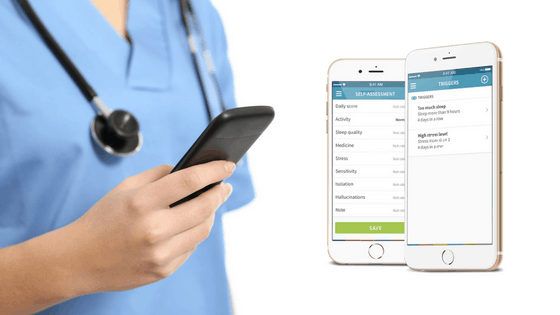
With help of the patient’s smartphone, the Monsenso mHealth platform utilizes advanced technology to collect and analyze data on a patient’s behavior. This collection and analysis of data gives the clinician a deep insight into the relationships between the patient’s behavior and the illness.
Expanded staff capacity
The Monsenso mHealth solution enables clinicians to focus on patients who need immediate attention by notifying clinicians automatically if there are any patients who present any triggers or early warning signs.
Enhanced training opportunities
The information on the clinical web portal can be accessed and shared by multiple clinicians even if they are not based in the same geographical location.
Cost savings
The smartphone application enables patients to fill out self-assessments on a daily basis letting the clinicians know how they feel. This information as well as the information collected through the smartphone’s sensors can help clinicians intervene at an early stage, before the patient needs hospitalization.
Patient acceptance and engagement
The patient-oriented clinical evaluations by Monsenso have shown that the compliance rate is very high (87% to 93%), the solution is very useful and extremely usable by patients and clinicians, it helps patients to manage their illness better, and it helps clinicians offer a better treatment
Reference:
[1] Increasing access to behavioral health care through technology. The U.S. Department of Health and Human Services Health Resources and Services Administration (2013, February). http://www.hrsa.gov/publichealth/guidelines/behavioralhealth/behavioralhealthcareaccess.pdf
Mar 20, 2017
mHealth offers the opportunity to offer scalable and cost-effective mental healthcare. One of the greatest challenges the healthcare systems face is the long-term care of individuals with severe mental disorders such as schizophrenia since the impact this has on individuals, families and societies is huge. Fortunately, some of these issues can be partially solved with the use of mHealth technology. Besides, the advantages of online therapy are many, including a more personalised treatment, patient-empowerment, teaching self-care and helping people who wouldn’t receive treatment otherwise.
Schizophrenia has an estimated point prevalence of 0.4% and a lifetime risk of 1%, which means that 1 in every 100 people will suffer from schizophrenia during their lifetime. It is the 7th most important illness in terms of years lived with disability, accounting for 2.8% of disability caused by all illnesses. For people aged 15 to 44 years, it is the 3rd most important disease, accounting for 4.9% of disability resulting from all illnesses.
During the last few decades, the European Union has made a huge effort to overcome these barriers and to ensure high-quality, longer-term care for people with severe mental disorders. These efforts started in the 60’s with the development of new pharmacological treatments for psychosis, which radically changed the prognosis of severe mental illness. In the 70’s and the 80’s, there was an emergence of new psychosocial interventions and new concepts of mental health care organisations [1].
Nowadays, there is a need to shift the health care model. The transition from traditional large psychiatric institutions to modern comprehensive community-based models of care, including acute patient units at general hospitals [1].
According to a report published by EU, this shift is necessary due to the following reasons:
- Accessibility to mental health care of people with longer-term mental disorders is much better with community-based services than with the traditional psychiatric hospitals
- Community-based services are associated with greater user satisfaction and increased met needs. They also promote better continuity of care making possible to identify and treat more often early relapses
- The community-based services protect the human rights of people with mental disorders and prevent stigmatisation of those people
- Studies comparing community-based services with other models of care consistently show significantly better outcomes on adherence to treatment [1]
However, European healthcare systems need to make lots of alterations if they want to provide accessible, effective, high-quality and long-term care to people suffering from severe mental disorders.
Challenges of the transition to new comprehensive community-based models of care
One of the main reasons why the development of long-term mental health services is insufficient is due to the lack of coordination between the different health services. A close coordination, and even joint funding and management of health and social care services is fundamental to cope with the new challenges European mental health systems are now facing. [1].
According to the report, these are the key principles to organise mental health services:
Accessibility: Essential mental health care should be available locally, including outpatient and inpatient care, as well as rehabilitative care. Local services provide continuity of care in a satisfactory manner.
Comprehensiveness: Mental health services should include all facilities and programmes required to meet the essential care needs of the populations.
Coordination and continuity of care: People suffering from severe mental disorders often find it extremely difficult to gain access to various basic services; therefore, it is crucial that services work in a coordinated manner. This coordination should also include services that are not directly related to health, such as social services and housing services.
Effectiveness: Service development should be guided by evidence of the effectiveness of particular interventions. For example, there is a growing evidence base of effective interventions for many mental disorders, among them depression, schizophrenia and alcohol dependence.
Equity: A person’s access to services of good quality should be based on need. It is quite often that the people who need these type of services the most are the least able to ask for help.
Respect for human rights: Services should respect the autonomy of persons with mental disorders, and encourage such persons to make decisions affecting their lives and treatment [1].
Scalable and cost-effective mental healthcare
The Monsenso mHealth solution does not only offer cost-effective mental healthcare, it can can facilitate five of the six points mentioned in the report to organise mental health services in an optimal way.
Accessibility: With mobile technology and telehealth, care providers can reach patients living in remote locations at a minimal cost. These technologies offer care providers more flexibility to deliver health care while on-the-go or from different locations—expanding the clinic’s service offerings [2].
Coordination and continuity of care: The Monsenso mobile health solution can facilitate and support the care of patients suffering from severe mental illnesses from community-based models. Due to its cloud-based model and unlimited scalability, patient records can be accessed by multiple organisations such as psychiatric institutions, general practitioners, and social services, among others.
Effectiveness and equity: With help of the Monsenso smartphone app, care providers can identify on a daily basis triggers and early warning signs of all patients in the system. With the Monsenso mHealth solution clinicians can prioritize caring for individuals who need immediate attention and continue to monitor individuals who are stable. According to the National Institute of mental health, early intervention is critical to treating mental illness before it can cause tragic results such as serious impairment, unemployment, homelessness, poverty, and suicide [4].
Respect for human rights: The Monsenso smartphone app enables patients to fill in daily self-assessments and write notes about how they feel. The information collected from these assessments is shared with the clinic, allowing individuals to be more involved with their treatment. The Monsenso smartphone app also provides individuals with customised action plans that act as guidelines in case their symptoms appear enabling individuals to take responsibility for their behaviours and actions.
References:
[1] The long-term mental health care for people with severe mental disorders. J.M Caldas de Almeida, H. Killaspy. Prepared under service contract with the Impact Consortium by the European Commission. 2011.
http://ec.europa.eu/health/mental_health/docs/healthcare_mental_disorders_en.pdf
[2] Increasing access to behavioural health care through technology. The U.S. Department of Health and Human Services Health Resources and Services Administration (2013, February).
http://www.hrsa.gov/publichealth/guidelines/behavioralhealth/behavioralhealthcareaccess.pdf
[3] Directors Blog: SAMHSA and NIMH partner to support early intervention for serious mental illness. P. Hyde and T. Insel. National Institute of Mental Health Blog (2014, June 17)
http://www.nimh.nih.gov/about/director/2014/samhsa-and-nimh-partner-to-support-early-intervention-for-serious-mental-illness.shtml
[4] Evidence based treatment for first episode of psychosis: Components of coordinated specialty care. PHD R. K. Heinssen. RAISE NIMH (2014, April 14).
http://www.nimh.nih.gov/health/topics/schizophrenia/raise/nimh-white-paper-csc-for-fep_147096.pdf
Feb 21, 2017
Using mHealth solutions for clinical trials as data-collection tools, can potentially revolutionise clinical research. Wearable devices and mobile health solutions can offer pharmaceutical companies access to additional patient data to provide a more comprehensive overview of safety and efficacy.
According to a new report by IMS Institute for Healthcare Informatics, there are now more than 165,000 mobile health apps on the market.
A report released in 2015 by Rock Health revealed that:
- 4 out of 5 internet connected adults use some kind of digital health technology
- 52% of consumers strongly agree that they are responsible for their own health
- 40% of people who made an online search for health information acted on the results of their search in some way
- 92% of users agree that they should be the one controlling their health data
- 80% of users would share their health data with their care provider to get better care [1]
The use of mHealth solutions for clinical trials is increasing, and according to industry experts, this trend will dominate the market in the coming years. In a recent SCORR Marketing report, 50% of industry experts surveyed say they use mHealth technology in their clinical trials and protocols, and of those 60% consider mHealth very important or critical to their research. [2]
As of August 29th, a search of clinical trials.gov showed 272 studies that mention the use of mHealth and 186 studies that mention a wearable. [2]
People use their mobile phones every day; it is the first and last thing they see when they wake up in the morning and before they go to bed. This is one of the reasons why the use of smartphones and wearables will continue to increase the use of mHealth solutions in clinical trials and pharmaceutical research.
The patient data obtained from mHealth devices, whether it is sensor or self-reported data, will transform the way patients are being diagnosed, monitored, and treated.
Additionally, the costs of conducting clinical trials are high, and mHealth technology has the necessary means to optimise the resources used and maintain lower costs. Mobile health data provides researchers with access to real-time data and visualisations that enable them to spot situations that otherwise would have been at best an indicator when reported through traditional clinical channels.
Additionally, pharmaceutical companies and researchers can immediately identify if a patient has stopped taking their medication or they present any unusual symptoms in real-time, and take action.
By using mHealth solutions, pharmaceutical companies expect to bring patients closer to the research and obtain better enrolment rates, compliance, and retention.
In addition to receiving information from patients, these devices can also be utilised to send information to the patients such as information about their condition and clinical questionnaires.
In the near future, pharmaceutical companies will be able to gather and visualise even more data in real time using mHealth technology, which will potentially shorten timelines, improve patient satisfaction, and increase future recruitment.
Interested in using mHealth technology for your clinical trial? Click here to learn more.
References:
[1] Rock Health: 80 percent of Internet-connected adults use digital health tools. J. Comstock. MobiHealthNews. (2015, October 19)
http://mobihealthnews.com/47675/rock-health-80-percent-of-internet-connected-adults-use-digital-health-tools
[2] MHealth in Clinical Research. Denise, Myshko. Pharma Voice. (2016, October)
http://www.pharmavoice.com/article/2016-10-mhealth/